Search This Blog

Thursday, January 12, 2012

800 MILES OF PIPE

One day, back in 2003, we got in our truck and headed south from Wasilla on the road to Valdez. In the wilderness of the tundra that is most of Alaska, we saw (here and there as it winds its way along) the famous Alaska pipeline.
Of course, this wasn't the first time we ever saw it. We used to see it when we lived in Fairbanks where it came close to the roads we traveled there.
We also saw it on the Dalton Highway on the way to the Prudhoe Bay oil field when we traveled as far north as possible on the gravel of the "haul road.".
See * below for information about how the pipeline was designed to protect the permafrost.
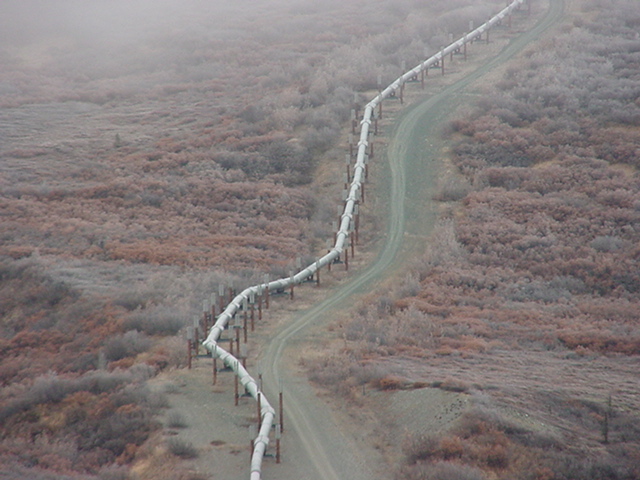
The pipeline sends oil over huge mountains, through dense forests and under rivers and roads with the help of 12 pumping stations situated all along the 800 miles of pipe that slices the State of Alaska in two.
The culmination of the forty-eight inch line is in Valdez, Alaska where the oil meets the tankers.


*Approximately 600 km of the pipeline is buried, while about 675 km is above ground to avoid burying the pipe in permafrost, which is ground that is continuously frozen for two years or more. Alyeska explains that because the crude oil is warm, heat from a buried pipe could warm the permafrost, making the soil in some areas unstable.

Where the pipeline is buried in permafrost it is either insulated or refrigerated to keep the permafrost from thawing. Refrigeration plants at each of these points circulate chilled brine through loops of 6 inch diameter pipe to maintain the soil in a stable frozen condition.

Above-ground portions of the pipeline sit on vertical support members (VSMs). The majority of the pipeline’s 78,000 VSMs are equipped with heat transfer pipes and radiators that keep the permafrost beneath the supports frozen. In areas where heat might cause undesirable thawing, the supports contain two pipes, 2 inches in diameter, containing anhydrous ammonia, which vaporises below ground, rises and condenses above ground, removing ground heat whenever the ground temperature exceeds the temperature of the air. Heat is transferred through the walls of the heat pipes to aluminium radiators atop the pipes.

In addition, the VSMs allow the pipeline to move a certain amount, both vertically and horizontally, in case of earthquakes and to compensate for expansion and contraction.

The above-ground sections have also been constructed in a zigzag configuration,which allows for expansion or contraction of the pipe due to temperature changes. This design also allows for any pipeline movement that might occur because of earthquakes in the area.

In areas of thaw-unstable soils where the pipeline had to be buried for highway, animal crossings, or avoidance of rockslides and avalanches, the line was insulated, to protect the permafrost from the heat of the pipeline, and buried.


Saturday, January 7, 2012

WHITE FANG - SUPER DOG (1991 - 1997)

 For a few years while we lived in Alaska, we were Privileged to own this beautiful Siberian Husky. She was a great companion and loved to run.


Sadly, she was poisoned by someone. To lose her was heart breaking.

Thursday, January 5, 2012

Bird of Paradise Flowers


 These flowers were photographed last year in the gazebo below. This year, Dave is still waiting for blossoms.

Thanks Dave!

Wednesday, December 28, 2011

A WALK ON THE BEACH

Come along with me for a walk on our beach. The views are always changing and yet, always familiar. We start, remembering the destruction of over three years ago and rejoice in the new construction that is all around us.
Still left from hurricane Ike damage. Let's see, that was September, 2008!

One of many new homes under construction.
This corner has two new houses.


One of our favorite houses - we call this one "Little Blue"
because a bit further on "Big Blue" is no more.


That is Galveston's harbor. You can see the towers for oil rig construction.

If you get your car too close to the water, you get stuck.
You are lucky if someone is there to push you out.


This sandpiper is going places. I believe he may be a "Yellowlegs."
 All kinds of gulls are there for us to see.


This is our "gulf" cart bridge.
This is the footbridge - built by our son.
(We don't see many turtles...)

Those are my footprints -  headed home.


My last view of the gulf and Galveston before I turn around and head to the house.
Thanks for coming along!

Tuesday, December 20, 2011

MERRY CHRISTMOOSE

Here is our tree.
I was going to have this collection as my Christmas decoration this year, but...

But then, I decided it would be better above the fireplace.
Would you like to see them closer?

These tree decorations were a gift from friends in Alaska - about 1971

I keep them in an egg carton between Christmases.

That's how they made it through the Hurricane!

HAVE YOU GUESSED WHAT THEY ARE MADE OF?

Saturday, December 17, 2011

LIGHTS OF CHRISTMAS


We will never see the lights of this house again. This picture was taken in December of 2004, long before anyone suspected we might be in danger some day from a giant hurricane.

This beautiful blue house was the largest in our neighborhood at that time, but it was no match for Hurricane Ike.
 On September 14th, 2008 (the morning after) all that was left were the ruins.


This year, 2011, this house on our street earned the award for the best lighting.
